
The Bible, Translation, and Conversations About Queer Children
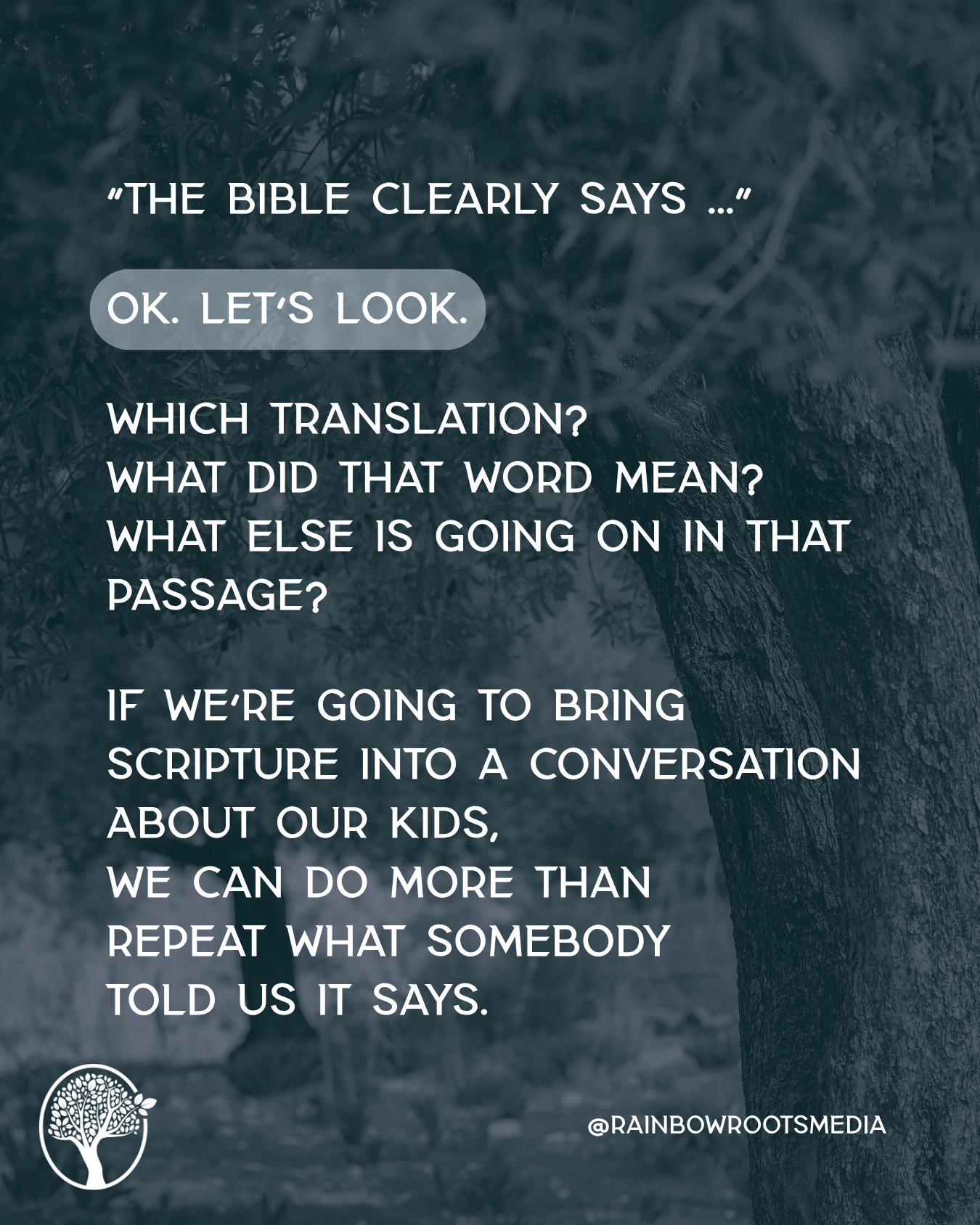
For many families, the Bible is not an abstract text. It is part of how they understand morality, family, identity, community, and what it means to live faithfully. So when questions about LGBTQ children enter the conversation, those questions can feel deeply personal very quickly.
This page is not here to tell anyone what they must believe. It is here to provide historical and linguistic context that is often missing when English Bible translations are treated as though every modern word maps neatly onto an ancient category.
That distinction matters.
Translation is not simply replacing one word with another. Translators make judgments about vocabulary, grammar, historical context, literary genre, and meaning. Those judgments can be careful and scholarly and still differ from one translation to another. That is especially important in passages involving sexuality.
A Few Things We Can Say With Confidence
The biblical texts were composed and edited across many centuries and in different historical and cultural settings. Most of the Hebrew Bible was written in Hebrew, with some portions in Aramaic; the New Testament was written in Greek. What survives today are manuscript witnesses and copies rather than the original handwritten documents themselves. Scholars compare those manuscripts in order to establish the earliest recoverable forms of the text. Major modern translations work from critical editions of the ancient Hebrew, Aramaic, and Greek texts, while also consulting ancient versions and earlier work by biblical historians and language experts.
In other words: the English Bible in your home is a translation of ancient texts produced through a long history of transmission, comparison, and interpretation. That does not make the Bible unreliable. It does mean that English wording has a history. And sometimes that history matters a great deal.
The Word “Homosexual” Is Modern
The English word “homosexual” emerged in the nineteenth century as modern sexology began developing categories of sexual orientation and identity. Biblical authors were not writing within that modern framework.
Ancient Mediterranean societies certainly discussed same-sex behavior, desire, relationships, gender roles, status, exploitation, prostitution, and sexual ethics. But they did not organize human sexuality around the modern heterosexual/homosexual identity categories in the way contemporary Western societies do. That is a significant difference.
It means that when a modern English translation uses a term such as “homosexual” or “homosexuality,” the translator is using a modern category to represent an ancient word or phrase. That may or may not be a defensible translation choice in a particular passage, but it is still a translation choice. Furthermore, the word “homosexual” does not appear in English Bible translations before the mid-twentieth century. The 1946 New Testament of the Revised Standard Version became a highly influential early English translation to use “homosexuals” in 1 Corinthians 6:9. Earlier translations used very different language.
Why 1 Corinthians 6:9 Gets So Much Attention
Two Greek words in 1 Corinthians 6:9 are central to modern debates: malakoi and arsenokoitai. They are difficult words, and translators have handled them differently for centuries. That fact alone should make us cautious about pretending the English wording is self-explanatory.
Malakoi
The Greek word malakoi is the plural of malakos, a word whose basic meaning is “soft.” Elsewhere in the New Testament, the same word is used for soft clothing.
In moral and social writing, however, the word could carry a much broader range of meanings, including weakness, lack of self-control, effeminacy, or sexual connotations depending on context. Scholars disagree about what nuance Paul intended in 1 Corinthians 6:9. Some interpret it sexually; others have emphasized broader moral or gendered meanings.
That disagreement is reflected in English translations. Some have used terms such as “effeminate,” some “male prostitutes,” and others have combined malakoi with the next Greek term into a single phrase referring to same-sex sexual behavior. Modern scholarly translations themselves signal uncertainty. The NRSVue, for example, includes notes stating that the meaning of the Greek terms is uncertain.
Arsenokoitai
The word arsenokoitai is rarer and more difficult. It appears in 1 Corinthians 6:9 and 1 Timothy 1:10. Many scholars believe the word may draw on the Greek wording of Leviticus, particularly because it combines terms related to “male” and “bed.” But the precise scope of the word is debated.
Some researchers understand it broadly as referring to male same-sex intercourse. Others argue for narrower meanings involving exploitation, prostitution, pederasty, or abusive sexual relationships. The available evidence has not produced a single uncontested definition that maps neatly onto a modern identity category. That is a critical distinction because behavior and identity are not the same category.
Even scholars who understand arsenokoitai as referring to male same-sex sexual activity are not therefore demonstrating that Paul was using the modern concept of “homosexual orientation” or addressing LGBTQ identity in the contemporary sense.
What Happened in the Revised Standard Version?
The 1946 Revised Standard Version rendered two Greek terms in 1 Corinthians 6:9 with the English word “homosexuals.” The translation included a note indicating that two Greek words had been represented by that single English expression. That wording did not remain unchanged. The 1971 revision of the RSV instead used the phrase “sexual perverts.” Yet, modern translations continue to disagree.
The current NIV uses “men who have sex with men.” The NRSVue uses separate expressions and explicitly notes uncertainty in the underlying Greek. The NET Bible uses yet another set of terms and provides extensive notes explaining its interpretive choices. The existence of those differences does not prove that every translation is equally persuasive.
It does prove that translation requires interpretation.
What This Does (and Does Not) Establish
Historical and linguistic study can tell us some things with reasonable confidence. Modern sexual-orientation categories are not the conceptual framework biblical authors were using. Ancient texts discussed sex and gender within different assumptions about family, status, social roles, power, purity, and behavior.
The Greek terms at the center of 1 Corinthians 6:9 are translated differently across respected Bible versions, and people who study the text, language, and historical context still disagree about their precise meanings. What historical-linguistic analysis cannot do by itself is settle every theological question.
Christians who share the same historical information may still disagree about biblical authority, sexual ethics, marriage, covenant, tradition, natural law, or how ancient teachings should be applied today. Those are theological questions.
This page is not trying to smuggle a theological conclusion in under the heading of “linguistics.” It is simply asking readers to distinguish what the ancient language can establish from what later theological interpretation adds.

Why That Matters for Parents
A parent may sincerely believe the Bible matters deeply. A parent may also discover that a verse they have heard summarized as “the Bible clearly says…” is linguistically and historically more complicated than they were taught. Those two things can coexist.
Faith does not require pretending translation history is simple. Conviction does not require ignoring ambiguity. And uncertainty about a Greek word does not need to become uncertainty about whether your child deserves safety, dignity, affection, and a relationship with you while you continue to study.
That is the part Rainbow Roots cares most about. You are allowed to ask difficult theological questions. Your child should not have to become the battlefield where those questions are settled.
An Invitation to Read Carefully
If you are a parent, family member, or faith-community member trying to understand what the Bible says about sexuality, slow down enough to notice what kind of question you are asking.
Is it a question about:
what an ancient word most likely meant?
what social practices existed in the ancient Mediterranean world?
how a translation committee rendered a disputed term?
what your religious tradition teaches?
how you personally interpret Scripture?
or how you will treat your child while you work through those questions?
Those questions overlap, but they are not identical. Keeping them separate can make conversations more honest. It can also prevent an English word chosen by a twentieth- or twenty-first-century translator from being treated as though it dropped unchanged from the ancient manuscript.
The Point of This Page
The point is not to tell you that the Bible is irrelevant. The point is to take the Bible seriously enough to read it carefully. That means respecting its languages, history, context, translation tradition, and areas of genuine scholarly disagreement. It also means being honest about where the text ends and our interpretation begins. For parents, that kind of honesty matters because interpretation has consequences. And when those consequences land on a child, accuracy is not an academic luxury. It is part of the responsibility.
Sources & Further Reading
This page is intended as a starting point, not a substitute for deeper biblical study, pastoral counsel, or further research. The sources below include Bible translations, academic research, and historical work representing more than one interpretive position.
Bible translations and textual notes
New Revised Standard Version Updated Edition (NRSVue), 1 Corinthians 6:9. The NRSVue renders the disputed Greek terms separately and explicitly notes that the meaning of each is uncertain.
New International Version (NIV), 1 Corinthians 6:9. The NIV renders the two Greek terms together as “men who have sex with men” and includes a footnote explaining its interpretive choice. Comparing the NIV with the NRSVue is a useful way to see how differently respected modern translations handle the same Greek vocabulary.
Revised Standard Version (RSV), 1 Corinthians 6:9. The later RSV wording uses “sexual perverts,” demonstrating that the translation tradition itself changed its English rendering over time.
King James Version (KJV), 1 Corinthians 6:9. The KJV’s older wording provides another useful comparison point and shows how substantially English terminology has shifted across centuries.
Academic research on malakoi and arsenokoitai
John Granger Cook, “μαλακοί and ἀρσενοκοῖται: In Defence of Tertullian’s Translation,” New Testament Studies 65 (2019): 332–352. Cook argues for a more definite sexual meaning for the terms and explicitly engages scholars who interpret them differently. This is useful precisely because it represents a serious scholarly case on one side of the debate rather than an affirming-only source list.
Bernadette J. Brooten, Love Between Women: Early Christian Responses to Female Homoeroticism. University of Chicago Press. A major historical study of female homoeroticism in the ancient Roman and early Christian worlds, including a detailed treatment of Romans 1. Brooten’s work is especially useful for complicating overly simple claims that ancient people had no awareness of enduring same-sex desire or relationships.
The scholarly debate summarized in Encyclopedia.com, “Homosexuality: Religious Perspectives.” This overview notes that scholars have interpreted arsenokoitai in different ways, including broader male same-sex activity, prostitution, pederasty, and exploitative practices, and also discusses disputes over malakoi.
For historical context
1 Corinthians 6 in context. Reading beyond verse 9 matters. The larger passage concerns disputes within the Corinthian community, sexual ethics, embodiment, and behavior more broadly; isolating one English word from the surrounding argument can distort the discussion.
Roi Ziv, “First Corinthians 6.1–6: Roman Court or Private Arbitration?” New Testament Studies 70 (2024): 160–173. This is not primarily about sexuality, but it is a useful example of how current research continues to revisit the social and legal context of 1 Corinthians rather than treating every traditional reading as settled.
A note from Rainbow Roots:
I am intentionally including research that does not collectively reach the same conclusion. If this page is asking parents to read carefully, I should do the same. My goal is not to win a theological argument by pretending the evidence is simpler than it is. My goal is to help parents understand where the language is clear, where it is disputed, and where interpretation enters the conversation.